Section Five: Miscellaneous Information about Victors and Victrolas
-
The Victor Talking Machine Company was founded in 1901. It was sold to RCA in 1929, right before The Depression hit. After that, the brand became "RCA VICTOR".
-
The Victor Dog's Name is Nipper. He is a mixed-breed Terrier. One story states that he was originally painted sitting on his master's coffin, listening to his voice played back on a phonograph. That is an "urban legend". It was simply a creative advertising idea.
-
Victor was the world's largest producer of musical instruments for many years, and employed over 8,000 people during its heyday. Victor's main plant was in Camden, New Jersey, but they also had plants in California, Virginia, Canada and Japan.
-
Victrola production reached its peak in 1917, selling just over 566,000 units that year. Then sales started to decline due to the breakout of World War 1. After the war ended, sales rose again, but never again matched the 1917 levels.
-
Phonographs became "the rage" in the USA between 1910 and 1921. Everyone wanted one, and a huge variety of models were introduced to fit every budget. Phonographs became commonplace in most households, and annual sales were growing at an incredible rate until radio was introduced (see below).
-
Victor held many of the key patents for flat-disc phonographs, and this protected the company from a great deal of competition (although some inventive work-around designs were produced by others). Victor's large legal team would fiercely litigate against any potential infringements on their patents, and they were victorious in the vast majority of cases filed in court. When the patents began to expire in the late 'teens, hundreds of upstart competitors appeared, which took a bite out of Victor's sales.
-
Edison's cylinder record patents protected them from competition as well, but Victor never was in the cylinder machine business. Eventually, the flat disc proved more practical (and cheaper to produce), and Edison reverted to their own unique flat disc design before going out of business in the 1920's.
-
You should use a steel needle only once (for one side of one record) and then toss it out. 78RPM records contain an abrasive which, by design, wears down the needle. The needle gets the wear...not the record. Once a needle is dull, it will quickly damage your records, so use a steel needle only ONCE! That was the case in 1910, and it still holds true today.
-
There were all kinds of special needles produced for Victrolas made from cactus, fiber, tungsten, etc. These are no longer produced. New steel needles are still readily available from a number of sources.
-
Approximately 800,000 external horn Victors were produced from 1901 through 1929, along with 7.4 million Victrolas, Electrolas and Orthophonics. Survival rates are estimated between 6% and 8%, meaning that well over 500,000 of these machines are still around
-
Most external horn Victor tabletop phonographs used solid wood-paneled cabinets. The majority of Victrolas use a composite wood core and thin veneer for the cabinets.
-
Victor produced the first electrically powered phonograph in the fall of 1913. At that time, very few homes had electricity, and in those homes with electrical power, plug-in outlets were usually not installed. Victor provided a 'lamp adapter' which allowed the user to unscrew a light bulb and use the light fixture to power the machine. These early electrical machines did not have amplifiers; only the motor was electrically powered. Amplifiers were not used until 1925.
-
The vast majority of Victrolas were originally sold in the months of November and December. They were great Christmas presents and the factory worked frantic overtime during those months.
-
Victors were sent from the factory to wholesale distributors, and from there to dealers. Consequently, there was a lot of mark-up in the retail pricing.
-
When introduced in 1911, the price-leader Victrola VV-IV made the phonograph affordable to many Americans. However, it's $15.00 price tag equates to $525 in today's economy.
-
Many Victrola aftermarket services existed in the 'teens and early 20's. These companies would decorate, paint or modify a Victrola to suit anyone's taste. There also were scores of companies who made a variety of custom cabinets for Victrolas.
-
One of the more expensive Victrolas listed in the catalogs was the 1927 VV 9-55 Electrola. Retailing for $1,550.00, it equates to approximately $29,850 in today's money. Far more expensive custom designs were available from the Victor Art Department.
-
Victrola dealers often attached a dealer tag or decal, indicating where it was purchased. Large dealer networks included the Wurlitzer Company, Grinnell Brothers, Lyon and Healy, John Wanamaker, and many others.
-
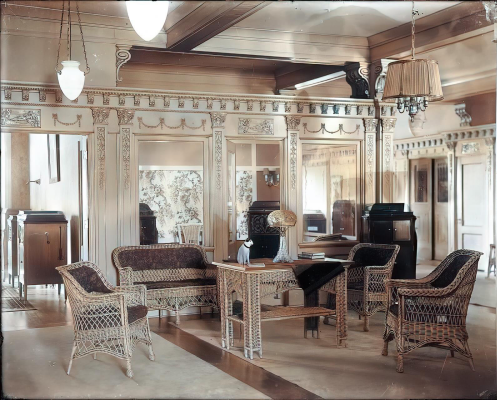 Buying a Victrola could be quite an elegant experience. Many upscale dealers
in big cities featured lavish, opulent showrooms (picture at right).
Buying a Victrola could be quite an elegant experience. Many upscale dealers
in big cities featured lavish, opulent showrooms (picture at right). -
The Victor Talking Machine Company came incredibly close to complete financial collapse in the Spring of 1925. The reasons? 1) Radio sales became the big thing. Old style phonographs were no longer selling. 2) Victor did a terrible job at inventory management. The factory kept pumping out Victrolas at full-speed while distributors were bursting at the seams with unsold machines. 3) Bad management decisions. When profits were tanking, Victor was building more plants and buying-out other phonograph companies. Revenues became so low in 1925 that Victor started making flooring products and furniture items just to keep the company going. Thousands of employees were laid-off. Total company assets vs. liabilities went negative in February 1925. Stock value fell from $1,500.00 per share in early 1919 to less than $1.00 in the early summer of 1925. The company was saved by introducing the Orthophonic line of machines in the late fall of 1925, along with implementing much-improved fiscal management procedures. But it never recovered to the profitability levels experienced during the late 'teens.
-
Victor dumped its excess inventory of older models in the late summer of 1925 by holding a national "Half-Price Sale". Retail prices were sliced by 50% or more. The company and dealers lost millions of dollars, but it was the only way that they could clear-out the massive amount of unsold inventory. If you currently own a Victrola built after 1923, odds are high that it was sold at half-price during the 1925 sale. It is interesting to note that many of the machines bought at half-price were likely given as Christmas presents later in the year; by that time they were probably unwanted gifts.
-
Acoustic Victrolas became totally obsolete and virtually worthless by the mid-1920's as inexpensive radios and electronic phonographs became the rage. Dealers would take the old machines in on trade-in, and then burn them in mass public bonfires. It became a rather popular advertising gimmick; "buy a new radio from us, and watch your old clunker go-up in smoke at the Courthouse Square!". Many virtually new Victrolas were traded-in, as their sound quality could not stand-up to the newer technology. If you bought an elegant VV-330 for $350.00 in 1924, the dealer would give you $32.00 in trade-in-credit for it against the purchase of a new radio just one year later. He would then most likely burn it since he probably couldn't sell it!! Talk about depreciation!
-
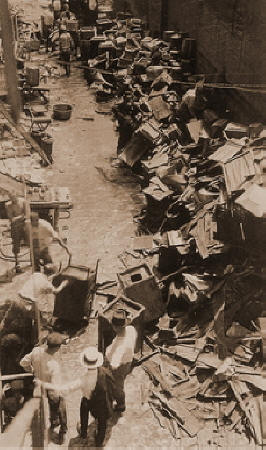 Deluxe (fancy) Victrolas were commonly
gutted and used as bookcases or bars in the 1930's and 40's. The spring
motors could be used as trolling motors for fishermen. During World War 2,
one company in New York would take old phonographs in "Victory Drives", pull
out the metal parts for meltdown, and grind-up the wood for use as
fiberboard (right).
Deluxe (fancy) Victrolas were commonly
gutted and used as bookcases or bars in the 1930's and 40's. The spring
motors could be used as trolling motors for fishermen. During World War 2,
one company in New York would take old phonographs in "Victory Drives", pull
out the metal parts for meltdown, and grind-up the wood for use as
fiberboard (right).
-
This website receives more than 180 emails and approximately 75 database submissions per day regarding surviving Victor products. The database information is used to track survival rates, details on model features, etc., and now contains over 220,000 entries. This site is the result of approximately 40 years of research and countless discussions with fellow collectors and experts. Traffic averages 2,400 hits per day.
-
Victor-Victrola went online during the fall of 1997, and contained 3 pages of information. It has since expanded to hundreds of pages, and is one of the most commonly used resources for antique phonograph collectors.
-
Four previously unknown models have been uncovered though database submissions, and over 50 extremely rare Victrolas have been discovered via contacts through this website.