Borgia II / VE 9-2
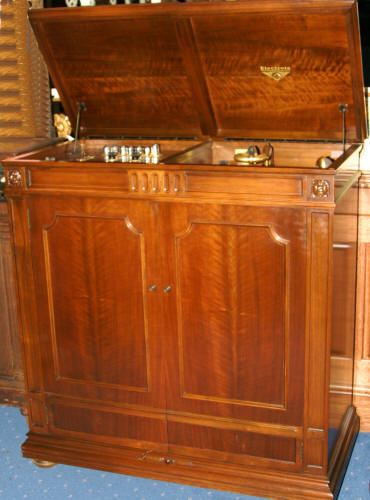
 The Borgia II was the top-of-the line model of Victor's "high end"
radio/phono combinations when introduced in early
1926. It was sometimes denoted as the "VE 9-2" in the catalogs, but
all dataplates are marked "Borgia II". It featured an RCA-produced Radiola Model 28 radio
(RCA's best set) and Victor's premium Orthophonic and Electrola phonograph with a large folded horn of similar dimensions as that used in the famous
"Credenza"
model. It also utilized a very early tube amplifier, producing about 5 watts of audio power. A small electromagnetic driver was coupled to the neck of the horn,
which allowed the radio's output to be heard with excellent volume and fidelity.
The user could then flip a large toggle switch to change the amplifier's input from the
radio to the electric pick-up when records were played. Also, for record playback, the user of
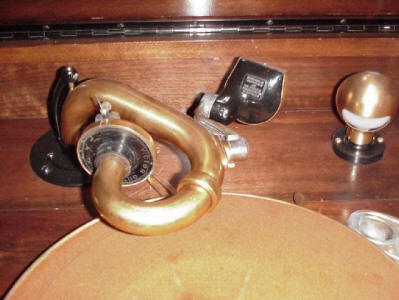
the Borgia II could select either acoustical reproduction or electronic
reproduction, as there were two phono soundboxes attached to the tonearm
(picture on right). While
the early amplifier provided plenty of volume, it also tended to exhibit
considerable "hum", which could be annoying when listening to soft
music. In that case, the user could just switch-over to purely acoustic
reproduction, which disabled the amplifier and provided a direct coupling of the
acoustic soundbox to the Orthophonic horn, thus eliminating unwanted noise.
All these
components were enclosed in a massive walnut cabinet that measured 44" wide and
over 45" tall. The Borgia II shared an identical cabinet and appearance with its
less-expensive cousin the Borgia I; the primary
difference being that the Borgia I offered only acoustic playback of records,
while the Borgia II provided a choice of electrical or acoustical reproduction.
The Borgia II also provided an AC Adapter, so that batteries were not required
to operate the radio (as was required on the Borgia I).
The Borgia II sold new
for $1,000.00, which equates to almost $19,000.00 in today's money. This
was the ultimate 'audiophile's dream-machine' of 1926; however the Borgia quickly became obsolete with the introduction of the vastly
improved performance of paper-cone speakers in 1927.
The VV 8-60 model was
the 'little brother' version of the Borgia II, as it shared the dual-playback
capability for records, but did not have a radio.
While few have survived, the imposing size and cost of restoration of these
early and complex models limits the interest of most collectors in the current
market. Rebuilding of the early tube amplifier alone can
cost well over $1,000.00.
Given the high cost when new, a surprising total of approximately
2,500 Borgia II's were produced, all manufactured in 1926. It
remained available at dealers well into 1927, and was
being significantly discounted by that time.
The Borgia II was the top-of-the line model of Victor's "high end"
radio/phono combinations when introduced in early
1926. It was sometimes denoted as the "VE 9-2" in the catalogs, but
all dataplates are marked "Borgia II". It featured an RCA-produced Radiola Model 28 radio
(RCA's best set) and Victor's premium Orthophonic and Electrola phonograph with a large folded horn of similar dimensions as that used in the famous
"Credenza"
model. It also utilized a very early tube amplifier, producing about 5 watts of audio power. A small electromagnetic driver was coupled to the neck of the horn,
which allowed the radio's output to be heard with excellent volume and fidelity.
The user could then flip a large toggle switch to change the amplifier's input from the
radio to the electric pick-up when records were played. Also, for record playback, the user of
the Borgia II could select either acoustical reproduction or electronic
reproduction, as there were two phono soundboxes attached to the tonearm
(picture on right). While
the early amplifier provided plenty of volume, it also tended to exhibit
considerable "hum", which could be annoying when listening to soft
music. In that case, the user could just switch-over to purely acoustic
reproduction, which disabled the amplifier and provided a direct coupling of the
acoustic soundbox to the Orthophonic horn, thus eliminating unwanted noise.
All these
components were enclosed in a massive walnut cabinet that measured 44" wide and
over 45" tall. The Borgia II shared an identical cabinet and appearance with its
less-expensive cousin the Borgia I; the primary
difference being that the Borgia I offered only acoustic playback of records,
while the Borgia II provided a choice of electrical or acoustical reproduction.
The Borgia II also provided an AC Adapter, so that batteries were not required
to operate the radio (as was required on the Borgia I).
The Borgia II sold new
for $1,000.00, which equates to almost $19,000.00 in today's money. This
was the ultimate 'audiophile's dream-machine' of 1926; however the Borgia quickly became obsolete with the introduction of the vastly
improved performance of paper-cone speakers in 1927.
The VV 8-60 model was
the 'little brother' version of the Borgia II, as it shared the dual-playback
capability for records, but did not have a radio.
While few have survived, the imposing size and cost of restoration of these
early and complex models limits the interest of most collectors in the current
market. Rebuilding of the early tube amplifier alone can
cost well over $1,000.00.
Given the high cost when new, a surprising total of approximately
2,500 Borgia II's were produced, all manufactured in 1926. It
remained available at dealers well into 1927, and was
being significantly discounted by that time.
The current survival database shows the earliest existent Borgia II to be S/N 548 and the latest to be S/N 2284.
Do you own a Victor Borgia II? Please take a moment and enter some basic information about your machine into the collector's database by clicking here. No personal information is required.