
The Victor-Victrola Page
Design Details:
1. Horns
3. Cabinet Features
4. Soundboxes
Pictures and details on some of the design features of External Horn Victor phonographs. Each sequential page covers one aspect of the evolving designs. Advance to the next page via the link above or at the bottom of each page.
Victor Cabinets Cabinets for Victor machines varied from nothing at all to simple plywood boxes to ornate custom-carved designs. Cabinets also evolved as the motor and tonearm designs improved.
 No
Cabinet/Base Mount.
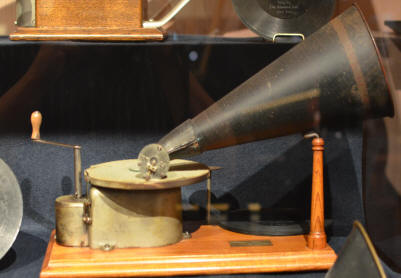
The earliest Victor machines (at first called
"Eldridge Johnson" phonographs) had no cabinet at all, leaving the motor and
other components completely exposed. The crank was wound from the top. The
horn is supported from the base plate.
No
Cabinet/Base Mount.
The earliest Victor machines (at first called
"Eldridge Johnson" phonographs) had no cabinet at all, leaving the motor and
other components completely exposed. The crank was wound from the top. The
horn is supported from the base plate.
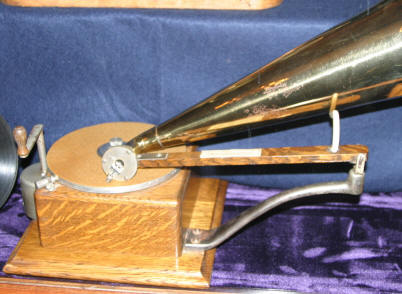
Top-winding/Front Mount Cabinet. Very early Victor phonographs (including the "no cabinet" types listed above) used a top winding crank, wherein the winding key (crank) is wound above the turntable. This required that no record be present on the turntable when winding. Note: some early machines used a "lever-arm" to wind the spring. This arm was pumped via a ratchet type mechanism. The horn is mounted via a support bracket on the front of the machine (facing the listener).
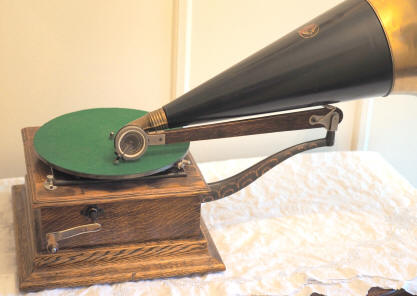 Side Winding/Front
Mount Cabinet. During the latter part of
1901, Victor converted to a more practical side-winding crank, which allowed the
user to wind the machine while the record remains on the turntable. The horn is mounted via a support bracket on the front of the machine (facing
the listener).
A huge variety of different
machines were produced using this design, which are covered under the individual
model listings. Some were plain, while others used elaborate
carvings and/or figuration.
From this point onward, cranks were always
mounted on the side of the cabinet. The "Front Mount" horn
support design was continued on some of the less expensive models through the
early 'teens.
Side Winding/Front
Mount Cabinet. During the latter part of
1901, Victor converted to a more practical side-winding crank, which allowed the
user to wind the machine while the record remains on the turntable. The horn is mounted via a support bracket on the front of the machine (facing
the listener).
A huge variety of different
machines were produced using this design, which are covered under the individual
model listings. Some were plain, while others used elaborate
carvings and/or figuration.
From this point onward, cranks were always
mounted on the side of the cabinet. The "Front Mount" horn
support design was continued on some of the less expensive models through the
early 'teens.
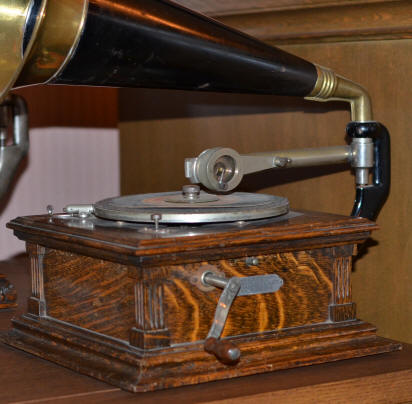 Rear
Mount Cabinet. When the "Rigid Arm" tonearm design came into being in
1902 on some of the premium models, the horn support bracket was moved from the front of
the machine to the rear. This cabinet configuration became Victor's standard
design for
the next 20+ years.
Rear
Mount Cabinet. When the "Rigid Arm" tonearm design came into being in
1902 on some of the premium models, the horn support bracket was moved from the front of
the machine to the rear. This cabinet configuration became Victor's standard
design for
the next 20+ years.
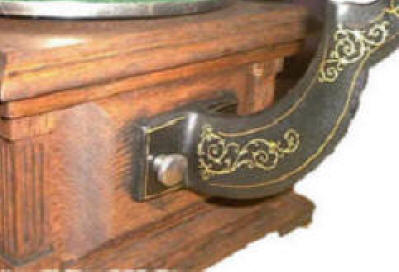 "Hump-Back"
Cabinet. Some
"Victor II" machines manufactured from 1906 through 1909 had an offset
section of wood to support the tonearm backbracket. This design is often called a "hump back" cabinet.
"Hump-Back"
Cabinet. Some
"Victor II" machines manufactured from 1906 through 1909 had an offset
section of wood to support the tonearm backbracket. This design is often called a "hump back" cabinet.
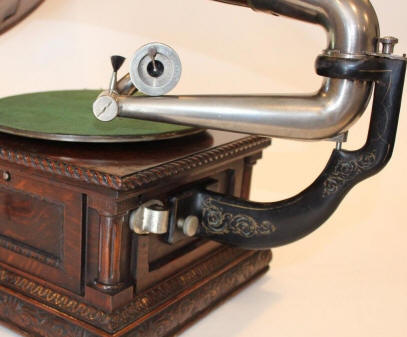
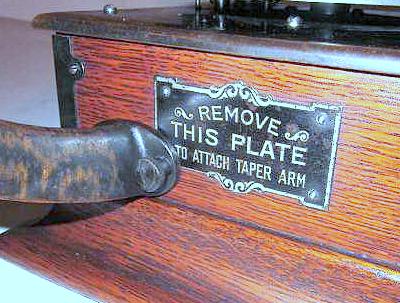 Note:
Blanking plates were used on some cabinets when
Victor transitioned from the integral horn design to the rigid or taper arm
configuration. During this transition time, many machines came with an
"option" of a newer-style rear-mount horn. When this change was made, the
front of the machine became the rear of the machine, and the larger horn
support bracket could be added if desired. Metal plates were
used to cover the mounting holes for the large back-bracket during the period of
transition when both designs were available. The blanking plates typically
appear as in the picture shown at left. Machines which were sold as "Front Mount" styles
could be converted to "Rear Mount" at a later time by the dealer. So one may
find evidence of both types of horn supports having been available via
the presence of additional bracket supports (right). Considerable variations in plate designs and/or wording
are common.
Note:
Blanking plates were used on some cabinets when
Victor transitioned from the integral horn design to the rigid or taper arm
configuration. During this transition time, many machines came with an
"option" of a newer-style rear-mount horn. When this change was made, the
front of the machine became the rear of the machine, and the larger horn
support bracket could be added if desired. Metal plates were
used to cover the mounting holes for the large back-bracket during the period of
transition when both designs were available. The blanking plates typically
appear as in the picture shown at left. Machines which were sold as "Front Mount" styles
could be converted to "Rear Mount" at a later time by the dealer. So one may
find evidence of both types of horn supports having been available via
the presence of additional bracket supports (right). Considerable variations in plate designs and/or wording
are common.