
The Victor-Victrola Page
 Victor
Trivia
Victor
Trivia
The Victor Talking Machine Company was founded in 1901. It was sold to RCA in 1929, right before The Depression hit. After that, the brand became "RCA VICTOR"
Victor was the world's largest producer of musical instruments for many years, and employed over 8,000 people during its heyday. Victor's main plant was in Camden, New Jersey, but they also had plants in California, Virginia, Canada and Japan.
It is estimated that over 75% of all Victor phonographs ever made were originally sold in the months of October, November and December. It was truly a "Christmas Tradition" to give a phonograph as a holiday gift.
Most Victor (external horn) machines have cabinets made of solid oak or mahogany. The Victrola (internal horn) machines used a layer of veneer over a dense composite core. This was done to prevent warping which is common over time on large panels of solid wood. It was also a lot cheaper to manufacture.
Approximately 800,000 external horn Victors, and over 7 million Victrolas (internal horn) came off the assembly lines by the time RCA bought the company.
Current estimates are that the survival rate for external horn phonograph models is about 4%. Internal horn Victrolas have an estimated survival rate of about 7%. That means that there are about 650,000 Victors and Victrolas still in existence.
You should use a steel needle only once (for one side of one record) and then toss it out. 78RPM records contain an abrasive which, by design, wears down the needle. The needle gets the wear...not the record. Once a needle is dull, it will quickly damage your records, so use a steel needle only ONCE! That was the case in 1910, and it still holds true today.
There were all kinds of special needles produced for Victrolas made from cactus, fiber, tungsten, etc. These are no longer produced. New steel needles are still available from a number of sources.
When introduced in 1911, the price-leader VV-IV made the Victrola affordable to many Americans. However, it's $15.00 price tag would equate to $275.00 in today's economy.
Victrola production reached its peak in 1917, selling just over 566,000 units. Then sales started to decline. They never returned to that level.
It was estimated that, for every dollar spent on buying a Victrola, an average of $3.00 was spent buying records. It was a very lucrative business model.
Victor's founder, Eldridge Johnson, and other early investors became incredibly wealthy. It is estimated that Mr. Johnson's net worth (in 2020 dollars) was in excess of $500,000,000 dollars during the company's heyday.
The Victor Dog's Name is Nipper. He is a mixed breed Terrier. One story states that he was originally painted sitting on his master's coffin, listening to his voice played back on a phonograph. That is an "urban legend". The painting was simply a creative idea, sold to Victor by an artist based in England.
Victors were sent
from the factory to wholesale distributors, and from there to dealers.
Consequently, there was a lot of mark-up in the retail pricing,
sometimes on the order of 75% above actual cost.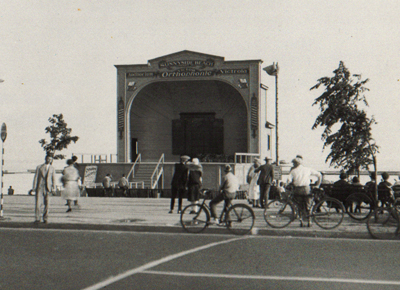
Many aftermarket services existed in the late 'teens and early 20's. These companies would decorate, paint or modify a Victrola to suit anyone's taste. There also were scores of companies who made a variety of custom cabinets for Victrolas.
Victrola dealers often attached a dealer tag or decal, indicating where it was purchased. Large dealer networks included the Wurlitzer Company, Grinnell Brothers, Lyon and Healy, John Wannamaker, and many others.
Victor set up spectacular large indoor and outdoor displays to promote their products, as shown at the right. This was a giant horn that played music to an outdoor audience! (Toronto Canada, 1926)
The Victor Talking Machine Company came incredibly close to complete financial collapse in the Spring of 1924. The reasons? 1) Radio sales became the big thing. Phonographs were no longer selling. 2) Victor did a horrible job at inventory management. The factory kept pumping out Victrolas at full speed while distributors were bursting at the seams with unsold machines. 3) Bad management decisions. When profits were tanking, Victor was building more plants and buying-out other phonograph companies. It got so bad that Victor started making flooring products and furniture items just to keep the company going. Total company assets vs. liabilities went negative in February. Stock value fell from $1,500.00 per share in 1919 to $0.35 in the summer of 1924.
Victor dumped its excess inventory in the late summer of 1924 by holding a national "Half-Price Sale". The company and dealers lost millions of dollars, but it was the only way that they could clear the massive amount of unsold inventory. If you currently own a Victrola built after 1922, odds are high that it was sold at half-price during the 1924 sale. It is interesting to note that many of the machines bought at half-price were likely given as Christmas presents later in the year; by that time they were probably unwanted gifts.
Acoustic Victors and Victrolas
became totally obsolete and worthless by the mid-1920's, as inexpensive
radios and electronic phonographs became the rage. Dealers would take old machines in on trade, and then burn them in mass public
bonfires. It became a rather popular advertising gimmick;
"buy a new
radio from us, and
watch your old clunker go-up in smoke at the Courthouse Square!"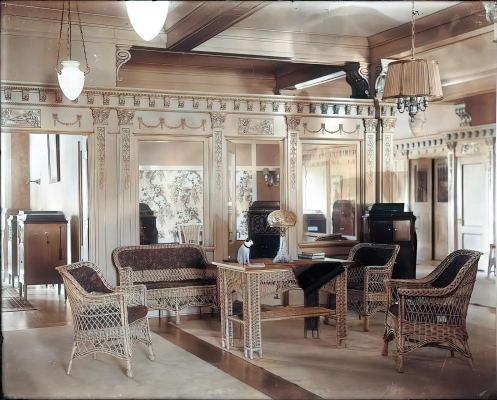 .
Many brand-new Victrolas were traded-in. If you bought an elegant VV-330 for
$350.00 in 1923, the dealer would give you $32.00 in trade-in-credit for it
against the purchase of a new radio just one year later. He would then
probably burn it since he couldn't possibly sell it!! Talk about
depreciation!
.
Many brand-new Victrolas were traded-in. If you bought an elegant VV-330 for
$350.00 in 1923, the dealer would give you $32.00 in trade-in-credit for it
against the purchase of a new radio just one year later. He would then
probably burn it since he couldn't possibly sell it!! Talk about
depreciation!
The new "Orthophonic" line of phonographs, along with updated radio-phonograph combination sets were quickly introduced in response to the collapse of conventional Victrola sales in 1925. These products literally saved Victor from extinction. However, while they were very successful, Victor's profits never came close to returning to the levels of 1915-1919.
Deluxe (fancy) Victrolas were commonly gutted and used as bookcases or bars in the 1930's and 40's. The spring motors were used as trolling motors for fishermen. One company in New York would buy old phonographs for 50 cents and grind them up for use as recycled fiberboard during World War II. Metal parts were given to wartime "scrap drives"
One of the more expensive Victrolas listed in the catalogs was the $1550.00 VV 9-55 Electrola. $1550.00 at that time equates to approximately $23,000.00 in today's money. Far more expensive custom designs were available from the Victor Art Department.
Buying a Victrola could be quite an elegant experience. Many upscale dealers in big cities featured lavish, opulent showrooms (picture on right).
This website receives more than 140 emails and approximately 75 database submissions per day regarding surviving Victor products. The database information is used to track survival rates, details on model features, etc., and now contains nearly 200,000 entries. This site is the result of approximately 35 years of research and countless discussions with fellow collectors and experts. Traffic averages 2,100 hits per day.
Four previously unknown models have been uncovered though database submissions, and over 50 extremely rare Victrolas have been discovered via contacts through this website.