Victrola Design Details
1. Cabinets 2. Cranks, Brakes and Speed Controls 3. Soundboxes and Keys 4. Lid Supports, Record Albums and Needle Trays
Design Details: Cabinets
Details on underlid decals can be found here.
All Victrola cabinets were produced in a wide variety of finishes and colors. Please see the section on FINISHES for more information. The section below covers the basic cabinet types that were produced.
Lidless Tabletop Models
Tabletop Models with Lid
Upright Floor Models
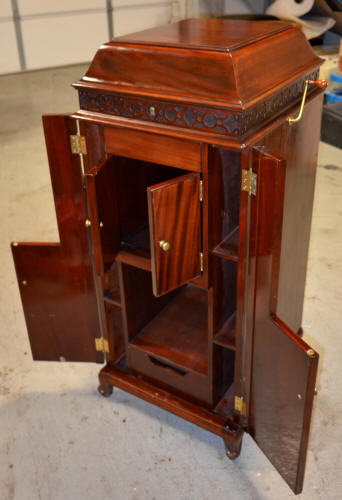
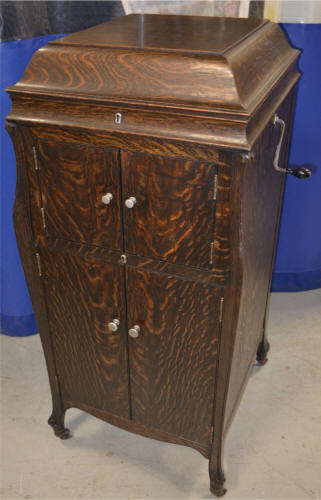
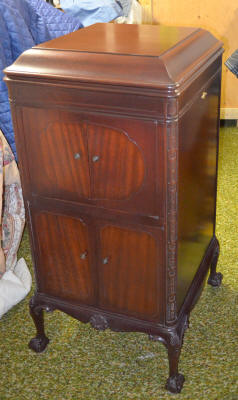
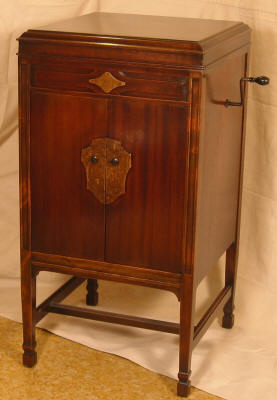
The most popular and common Victrolas were the upright floor models. The very first Victrola used this design in 1906, and variations of the upright floor model configuration continued until the Orthophonics were introduced in late 1925. Popular examples of this style include the "VV-X" and "VV-XI" (shown on left), "VV-XIV", and "VV-100". "Conventional door" Victrolas (left) have simple rectangular storage and "tone doors" (the top doors, which are used to control the sound volume during operation). Many variations of the floor cabinet design exist. The "Victrola XVI" (initially designated as "VTLA" on the dataplate) used a pair of unusual L-shaped storage doors with the tone door opening in the middle (right), which are referred to as "L-door Victrolas". These were produced until 1912, when the XVI transitioned into a conventional door design. Queen Anne type floor models are readily identified by the use of gracefully curved long legs supporting the cabinet. Upright Victrolas were discontinued in 1925.
Hump-Back Console Models
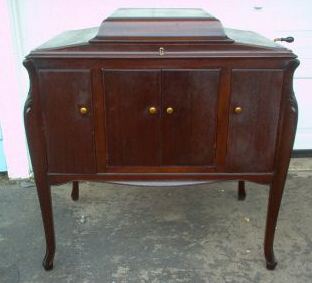
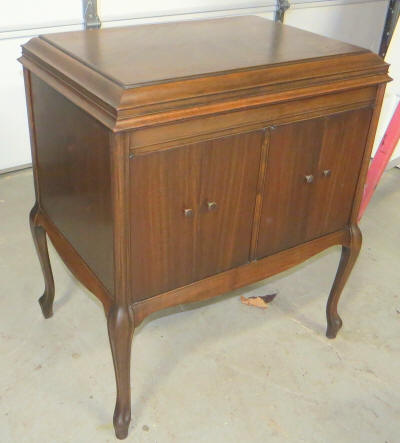
Flat-Top Console Models
"Art Case" Models
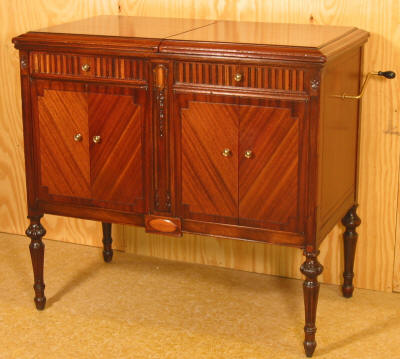
Phonograph sales began slowing significantly in the latter part of 1924, so Victor introduced a series of "Art Case" models, which were priced above standard models, but still considered to be affordable. These were produced in both the "console" and "upright" styles, and featured deluxe (machined) carvings and details, along with fine veneers. This was at a time when radio began to overtake phonographs as the preferred choice for home entertainment, and the Art Case machines (with the exception of the "VV-405") did not sell very well. Most were actually sold during Victor's "Half-Price" sale in the summer of 1925. Examples would include the "VV-410" (left), "VV-350", and "VV-370" (right).
Radio Adaptable Models ("S" prefix)
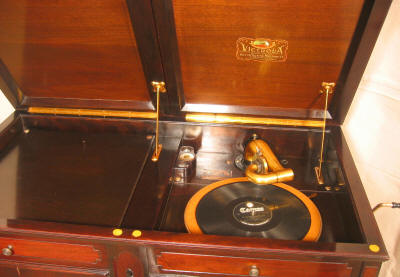
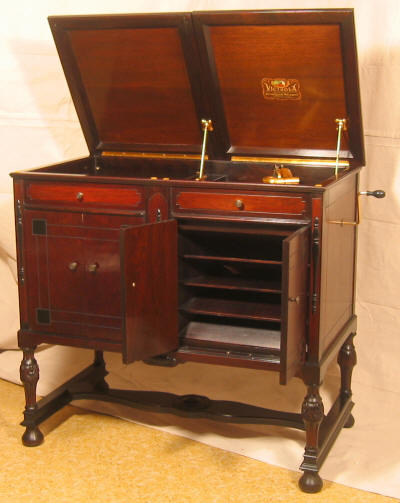
When radio started providing some serious competition for phonographs, Victor made an attempt to "get on the bandwagon" and offer Victrolas that could be adapted to include a radio. Since Victor did not produce radios in 1924, they modified the cabinets of some of their more popular console models so that the user could add an aftermarket radio, and have an "entertainment center". Dealers who also sold radios would often integrate the them into a Victrola cabinet for the customer. It was not a convenient setup however. The user had to remove the soundbox from the tonearm and replace it with a electromagnetic driver, thus using the Victrola horn as a "speaker". The radio was then powered-up with external batteries. Results were often marginal, since the phonograph horns were not originally designed to function in this manner. The Victor factory did not install radios into their cabinets; therefore "S" model Victrolas were shipped with a "blanking plate" covering the radio section on the left of the cabinet. If the dealer or buyer did not add the radio, then the machine would remain with the blanking plate in-place. Most of these models were sold during Victor's "Half Price Sale" of 1925, since they were not big sellers when introduced. Radio Adaptable models could be readily identified by an "S" prefix before the model number, and by the fact that there are two independent opening lids. Examples are the "VV-S-215", "VV-S-410" and "VV-S-405" (left). The view inside the cabinet (right) shows the radio blanking plate on the left side of the cabinet; this example never had a radio added, which was a common occurrence.
Period Models
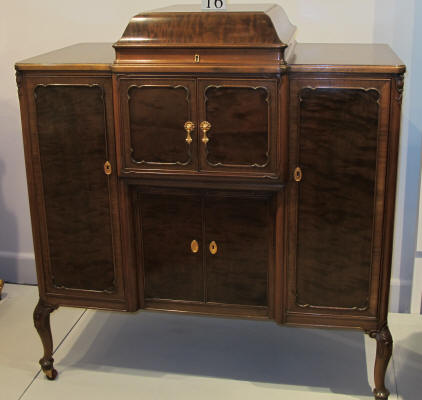
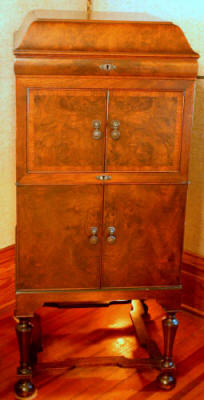
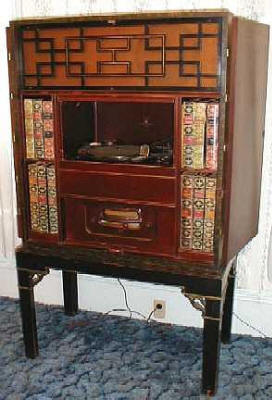
Victor's most elaborate and expensive machines were the "Period" models, produced between 1917 and 1924. These were made in very limited quantities, and came in both upright (left) and console (right) configurations. Most Period Victrolas had elaborate carvings, exotic woods and special finishes in their design. The Period machines were designated by model names such as "Hepplewhite", "Sheraton" or "Queen Anne". These are amongst the most desirable and valuable Victrolas.
Special (SP) Models
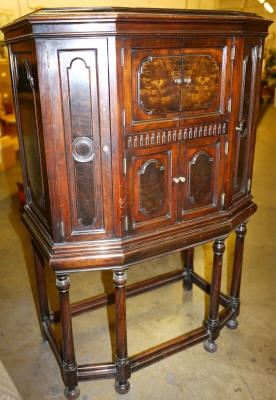
Orthophonic Models
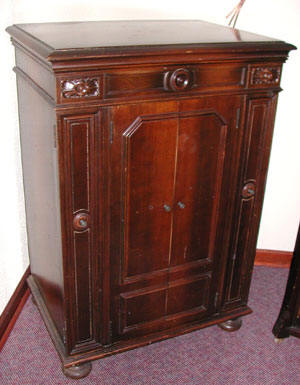
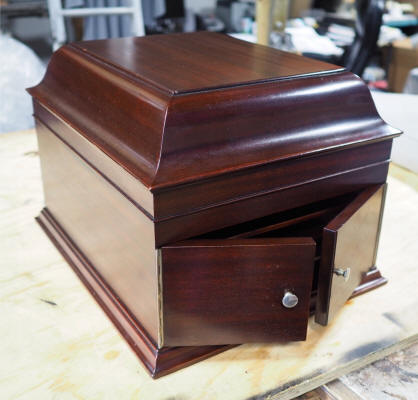
With the introduction of the Orthophonic Victrolas in 1925, the old upright and console designs were eliminated in favor of a more contemporary appearance, which used Renaissance, Colonial, and similar stylistic influences. Orthophonic models still used acoustic reproduction (no electronics), but with larger, more technically sophisticated horns and soundboxes. These machines appeared in a variety of shapes and sizes, typically with a blended-stain finish. Ornate hand carvings were eliminated, and the veneers were not of the same quality as were previously used, making the new models more price-competitive with other phonograph makers. The first Orthophonics used a name, such as "Consolette", "Granada" or "Credenza" (right), rather than a model-number identification. Later versions used model numbers such as "VV 4-3", "VV 4-7 (right)", and "VV 8-35". Some models provided an automatic record changer. Orthophonic Victrolas were produced until 1929.
Electrola / Orthophonic Combination Console Models
Portable Models